
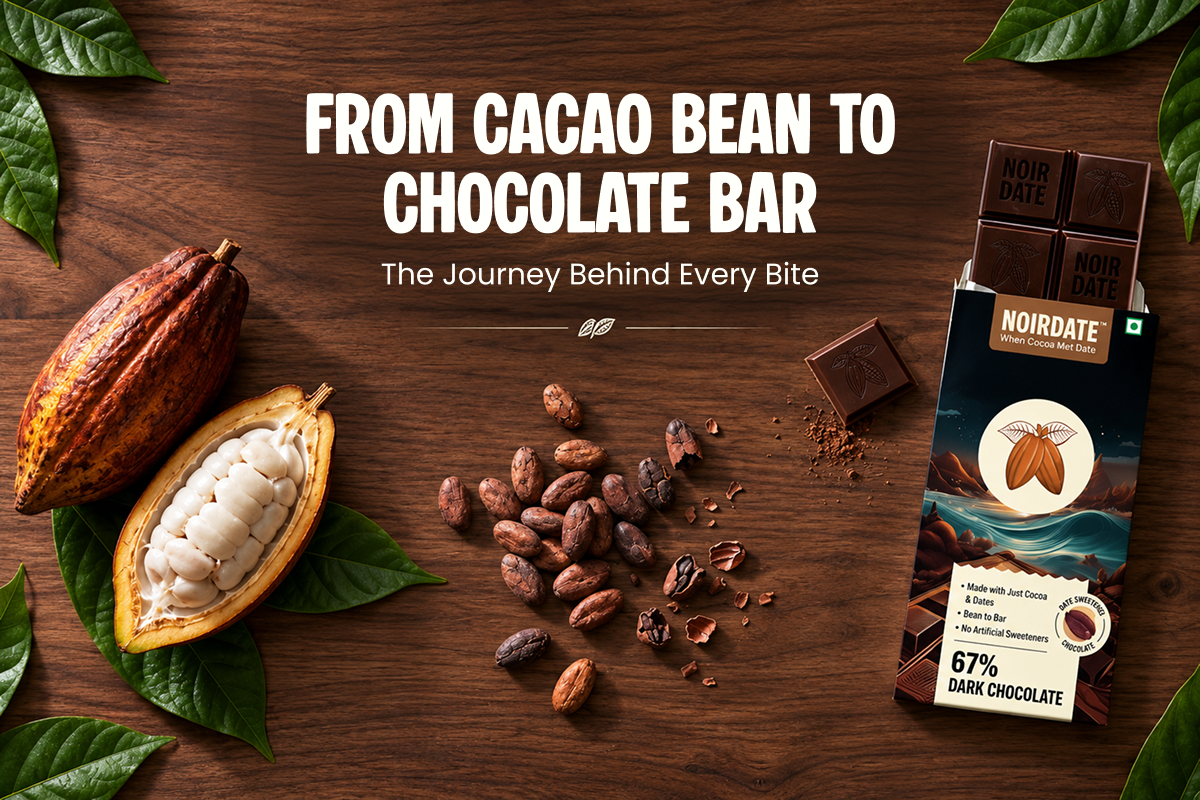
From Cacao Bean to Chocolate Bar
The Bean-to-Bar Chocolate Journey
Pick up any chocolate bar and you hold centuries of craft in your hands. Yet most of us have never paused to ask how it got there — how a rough, bittersweet cacao bean became the smooth, snapping rectangle of flavour you just unwrapped.
The journey is longer and more deliberate than most people realise. And once you understand it, you will never look at chocolate the same way again.

It Begins with a Pod
The cacao tree's single pod holds 20 to 60 beans wrapped in a sweet, citrusy white pulp called mucilage.
Harvesting is done entirely by hand — machetes remove each pod with precision to protect the tree's delicate floral clusters. The pods are split open and the wet beans, pulp and all, scooped into wooden fermentation boxes.

Fermentation: Where Flavour Is Born
If there is one step that separates mediocre chocolate from extraordinary chocolate, it is fermentation. Raw cacao beans are astringent and taste nothing like chocolate. Covered in their sugary pulp and heaped into wooden boxes for five to seven days, local yeasts and bacteria get to work. Temperatures climb to 45–50°C. Sugars convert to alcohols and acids. Bitter compounds are neutralised. And the aromatic precursors that will eventually become chocolate flavour begin to develop.
This is why origin matters so profoundly. Beans from Kerala's Western Ghats develop entirely different flavour profiles from beans in Godavari delta & coastal regions of Andhra. The microbial environment, ambient temperature, and post-harvest traditions all imprint on the bean. Terroir, in chocolate, is not a metaphor — it is literal chemistry.
Sun-Drying, Sorting and Sourcing
After fermentation, beans are spread under open sun for several days. Slow sun-drying stops fermentation at exactly the right moment and allows residual acidity to mellow, preserving aromatic compounds that mechanical drying destroys.
Bean-to-bar producers then evaluate every batch — removing flat, broken, or poorly fermented beans by hand. This direct sourcing also enables complete traceability: a true craft maker can tell you the farm, the harvest season, and the fermentation protocol behind every bar.

Roasting, Cracking and Grinding
Roasting is where the chocolate maker's skill first becomes visible. Gentle, low-temperature roasting coaxes out the specific character of each bean without scorching the fruity and floral notes that fermentation created — notes that industrial high-heat roasting simply erases.
After roasting, the outer husk is cracked and removed through winnowing, leaving the cacao nib — the purest expression of the bean.
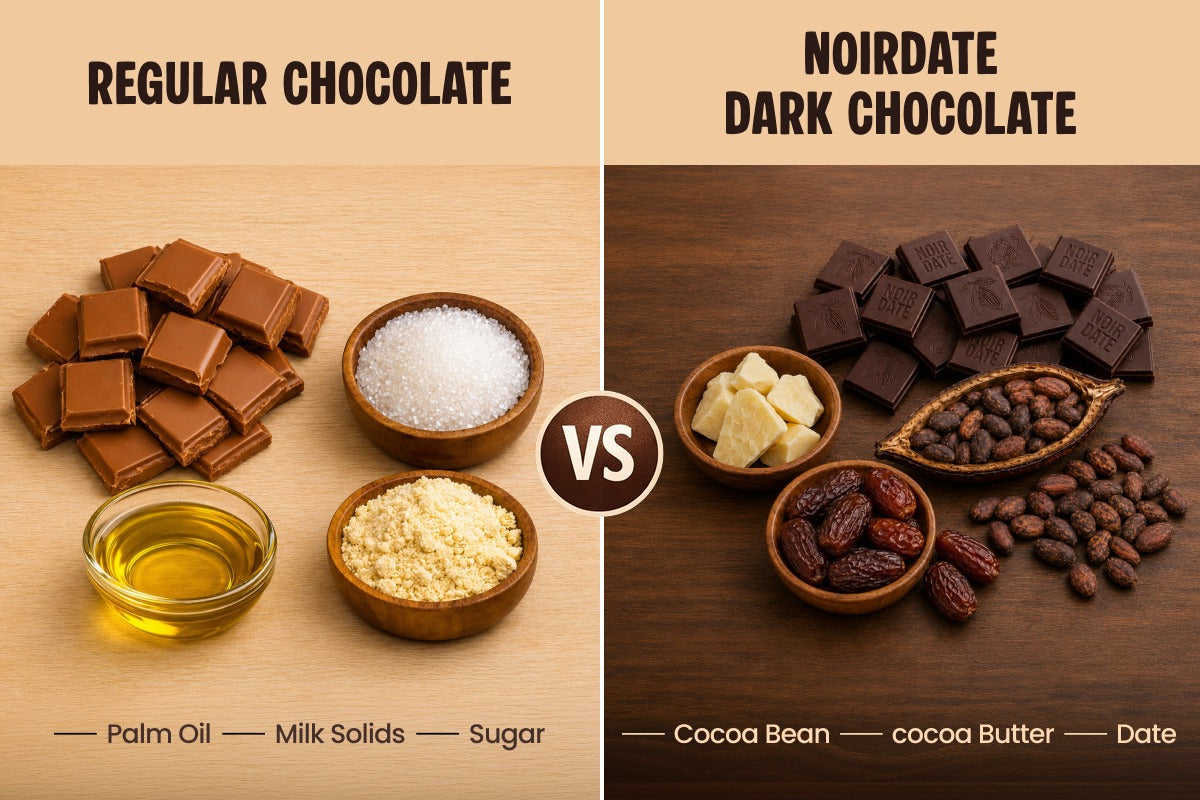
These nibs are fed into a stone grinder, a melangeur where granite rollers grind them continuously for 24 to 72 hours. Friction melts the cocoa butter naturally present in the nib, producing cocoa mass: pure, liquid cocoa. Any additional ingredients are added here — at Noirdate, that means the natural sweetness of real dates, not refined sugar.

Conching and Tempering: The Final Craft
Conching is where chocolate moves from technically correct to genuinely exceptional. Continuous mixing and gentle heating over hours — sometimes days — evaporates volatile acids, smooths the texture, and rounds out the flavour. Rushing this step leaves residual harshness in the bar.
Tempering is the final technical challenge. Cocoa butter crystallises in multiple forms; only one — Form V — produces a bar with a glossy surface, satisfying snap, and stable shelf life. A correctly tempered bar snaps cleanly, melts at body temperature, and releases its flavour all at once. That snap is not incidental. It is evidence of precision.
Why Bean-to-Bar Is Not Just a Label
Most chocolate is made by large companies buying pre-processed cocoa mass from industrial suppliers, blending it for uniform, anonymous flavour. Bean-to-bar means a single maker controls every step — fermentation to finished bar.
Every decision directly shapes the final flavour. There is nowhere to hide.
India is quietly producing some of the world's most interesting cacao. Beans from Kerala and West Godavari in Andhra Pradesh carry genuine complexity — jaggery, cashew, tropical fruit, gentle spice. A new generation of Indian craft makers is building entire brands around this, proving that Indian cacao, treated with care, can stand alongside the world's best.
What This Means for What You Eat

Understanding this journey changes how you read a label. The cocoa percentage tells you how much of the bar is actually cacao. The origin tells you where the flavour comes from. The ingredient list tells you whether the maker trusted their bean enough to let it lead.
A short, honest list — cocoa mass, cocoa butter, a natural sweetener — signals a maker who started with great beans and trusted the process. At Noirdate, every bar begins at the source: cacao hand-harvested from Indian farms in Kerala and Andhra Pradesh, fermented in traditional wooden boxes, sun-dried, small-batch roasted, stone-ground, and conched without shortcuts. Sweetened with real dates, not refined sugar. A three-ingredient bar where the cacao bean is the hero.
The best chocolate does not announce itself. It unfolds — slowly, completely — revealing layers that only exist because someone refused to rush the process.
Explore bean-to-bar dark chocolate crafted from Indian cacao · noirdate.in

Leave a comment
This site is protected by hCaptcha and the hCaptcha Privacy Policy and Terms of Service apply.